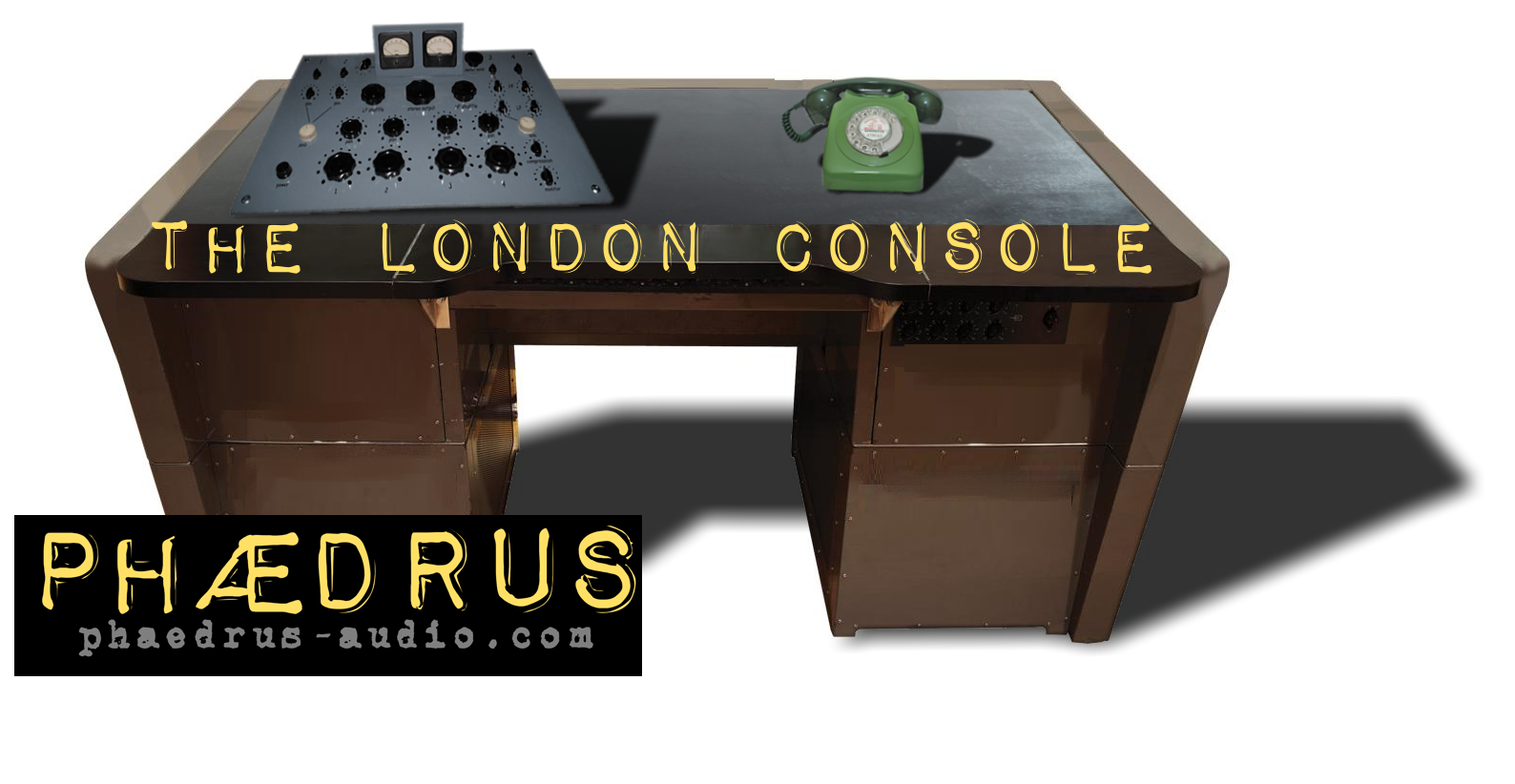
The London Console came about because, as two, amateur, recording musicians we wanted to own a "classic" console from the nineteen-sixties. Ideally a famous EMI REDD mixer.
But those desks make a collection of hen's teeth look positively prosaic - as well as cheap!
So, we set about researching with the idea of producing a replica console. But, very soon, we realised that this was neither practical nor, in fact, desirable; because, although we sought the 1960's console "sound", we wanted (like everyone else!) to be able to record digitally onto a PC to be able to use ProTools as the recording and editing environment.
The requirement therefore was for a tracking mixer with clean mic' channels (complete with classic inductor-capacitor EQs) and a simple mixer. The brief also included the option to employ a "classic" compressor-limiter in the chain. Subsequent revisions to the spec' included a line-up oscillator, for aligning the digital recording level to 0VU in the desk, and a slate mic' input; for identifying takes in a live recording. Provision was also to be made for FX send-and-return; principally for reverb.
So, the London console "evolved". A desk that is not copied directly from any particular desk, but instead is inspired by sections of Neve, Helios, UREI, and yes,...... the EMI REDDs.


The EQ circuit insertion-loss is made up by a further, class-A "inter-amp" which provides the low impedance drive to the faders and pan-controls. Signals are also picked-off at this point to feed the FX send. The latter are mixed and band-pass filtered before being made available at the FX output.
On channel 3, a compressor-limiter is incorporated, this being largely intended as the "Vox" channel. Once again this is an all discrete design in the signal path (although op-amps are used in the side-chain) and further incorporates one half of a double-triode valve (tube) in the recovery amplifier. Inspired from a very famous FET-based compressor launched in 1966, this technology fitted the brief to remain a "sixties console" perfectly.
The fader, channel-mute switches and pan controls assemblies are lossy too (approximately -12dB overall). So signals from here pass to the mix amplifiers where the attenuation gain is made up.
These bus signals ultimately feed the output channel amplifiers (all discrete transistors again), the metering circuits and the monitoring mixer, which allows for a stereo return signal to be auditioned and mixed with the track signal - available on headphones and on a dedicated control-room output.
But, before the stereo bus reaches the output amplifiers the mixer incorporates very unusual circuitry not seen in a mixer since the days of the EMI REDD consoles.
In effect, a standard, panned stereo signal (or that derived from crossed-mic's) has the drawback that, for a given position away from centre, or of the pan-pot away from the centre, the high-frequency components of a signal actually appear further from the centre in the reproduced "stereo-image" than do the lower frequency components. As Abbey Road's technical notes to the REDD .51 mixer note,
The result of not utilising the Stereosonic Shuffler, on a real music signal is a "smeared" stereo image in which the high and low frequencies are not "mapped" on top of one another. The image below is an attempt to give a visual analogy for this effect.
Another analogy is chromatic aberration in a lens, in which the high frequency blue light is refracted differently to the low-frequency red light.
EMI's solution to this was to incorporate sum and difference circuits into the stereo bus of the REDD mixers (derived in a series of transformers) and introduce HF loss into the difference circuits so that, when matrixed back to left and right signals, the required correction had been made.
This method however has the disadvantage that the HF-loss filter-circuits require phase-correction to be applied and moreover require that the sum circuit be delayed. As Abbey Road peperwork notes,
The result, together with the matrixing transformers, is a very expensive assembly, illustrated below.
This expense, as well as irresolveable problems of slight audio colloration due to inaccuracies in the phase-correction circuits (note the hand-written "almost" and "substantially" in the text above.), led this vital circuit to be ignored in later stereo equipment. Uncorrected stereo was reckoned to be "good enough".
It's important to point out what this actually means: that all stereo recordings are "broken" and have been since EMI threw the last of their REDD mixers on the dumpster. (Yes, they really did that!).
However, there is another way.......
Happily, there is an alternative, cheap and non-distorting alternative to the EMI Shuffler. One of Phaædrus' founders (Richard Brice) had designed a circuit similar to the EMI Shuffler back in the 1990s to correct for this problem in recorded stereo.
Richard used a crosstalk circuit directly between left and right channels, instead of operating on the difference-circuit. This has the great advantage that phase-correction circuits are not required. The resulting device (briefly marketed in a hi-fi and studio form) was known by the monstrous acronym of FRANCINSTIEN (FRequency-dependant, ANalogue, Crosstalk Injection Network for STereo Image ENhancement). As Richard put it, by incorporating the FRANCINSTIEN into a mixer, the London Console is,
the first "real stereo mixer" for fifty years!
What's more, we realise can even improve on what was done in the FRANCINSTIEN! In those days we couldn't do some of the analysis, PCs just weren't powerful enough. Now it's easy. As Richard says,
What I've found out recently is that both The EMI shuffler and the FRANCINSTIEN "over-cook" the correction, so that - even though the central image is greatly enhanced, the HF correction towards the edge of the image actually distorted too much. The latest FRANCINSTIEN circuit is even better. We've code-named it, Bride of FRANCINSTIEN!
The output stage of the power amplifier is modelled so that the effect of push-pull beam-tetrodes (with the characteristic s-shaped transfer characteristic), or with single-ended tetrode configuration. The former is responsible for the familiar "chime" of this circuit configuration, the latter with the hotter, "slightly choked" quality.
The circuit model is accurate down even to the input impedance, important because the pickup inductance and cable capacitance together, with the amplifier input impedance form one of the most characteristic resonant circuits responsible for amplifier "voicing". Guitar amp's which feed directly into bipolar input stage (whether op-amps or discrete), sound is "dead" because of this. The guitar signal literally fails to "make it to first base!"
Address all mail to sales@phaedrus-audio.com