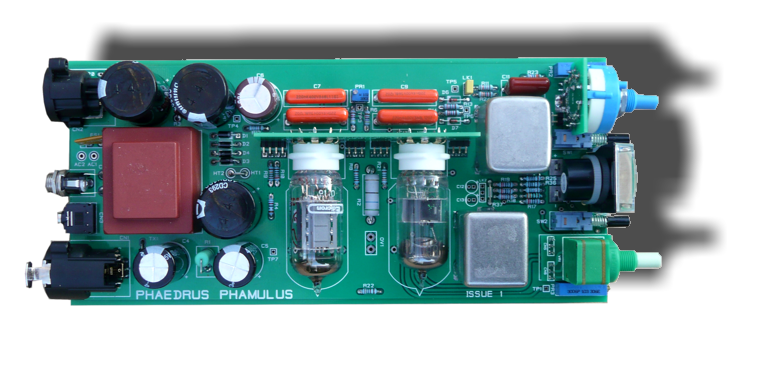

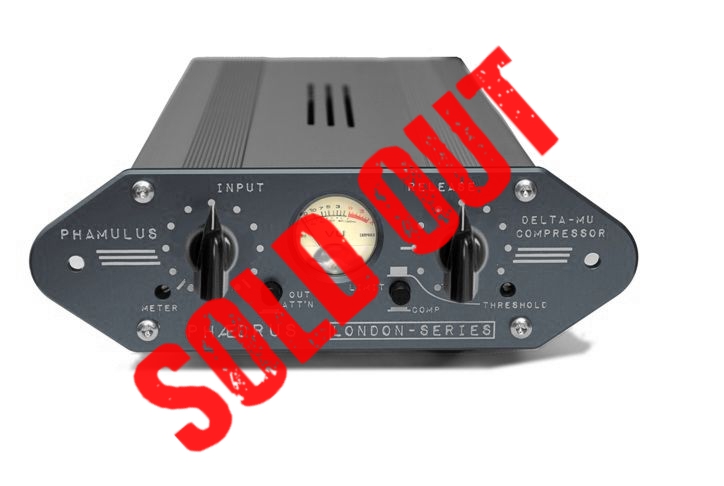

Compressors and limiters enjoy a fundamental similarity. In a limiter, the knee of the compression curve (the threshold) is set way up the transfer function, after which a very high degree of compression is imparted on the input signal. In a compressor, a lower degree of compression (compression ratio) is imparted at a lower threshold. Most modern compressors provide controls to adjust both compression threshold and ratio, so it is logical to speak of these units as compressor/limiters because they can function as either.
However in older tube-based units, such as the equipment the Phædrus Audio PHAMULUS is based upon, these functions are combined in a gradual characteristic. The user operation of this equipment therefore largely relies on how "hard" the equipment is driven to alter the dynamic range of the incoming signal. By applying low-level drive - by means of reducing the drive via the input attenuator - this equipment will only impart a gentle compression characteristic.
By driving the equipment with a high-level signal (by simply advancing the "input" level control), more and more of the dynamic range will be compressed.
In fact, the distinction between the term "limiter" and "compressor" was not well defined until the nineteen-seventies, so you will often find classic compressors were referred to by their manufacturers as "limiters", "limiting amplifiers" or "compression amplifiers.
The Phædrus Audio PHAMULUS is based upon the classic design of the Altec Lansing 436C Compression Amplifier.
The solution to the problem came in the shape of a post-detector, filter circuit with a time-constant long enough that it removed all the audio modulation and left just an overall DC voltage value dependent on the average amplitude of the RF carrier. This signal was then used to adjust the gain of the radio frequency (or intermediate frequency) amplifiers prior to detection. By this means, the overall value of the radio carrier was held steady and the volume of the detected modulation always remained that of the broadcast signal. How was the variable-gain accomplished? The answer lies in the inherent non-linearity of the valve (tube) which is deliberately exploited in radio valves to offer the AGC function.
Suppose that - for the moment - the radio set is receiving a strong signal. In this circumstance, the filtered AGC control voltage taken after the detector is large and this is so arranged to "slide" the input signal to the left-hand portion of the curve in the figure above. If the signal level drops, initially, the volume of the signal drops too. But, in a fraction of a second (the usual control delay is about 1/4 of a second), the AGC control voltage falls and biases the operating range of the valve to the right of the characteristic, thereby restoring the RF level, and with it, the recovered audio. So important was this development in radio sets, that radio valves are especially designed to maximise the curvature of the transfer-characteristic, these types of vales being known as "vari-mu" valves: the μ (mu) relating to the coefficient of gain.
Another term for vari-mu is "remote cut-off" which describes the fact that the cut-off point for the valve (the negative voltage at which the anode current ceases), is made as "remote" as possible from 0V, thereby prolonging the curvature of the Vg/Ia characteristic. The alternative to "remote cut-off" valve is a "sharp cut-off" device. Audio valves are "sharp cut-off" types; which means that the Vg/Ia characteristic is made as linear as possible. This is one of the reasons why radio valves make poor devices for audio applications.......except as the basis for compressors!
Of course, we might justifiably call "volume compression" by the equally valid term "audio automatic-gain-control" or "audio-AGC", so it is not surprising that the earliest compressors adopted the radio technology and applied to audio signal circuits. The only difference between a volume compressor and an AGC circuit is that - in the case of the former - it is the audio signal itself which is rectified and used as the control signal, rather than the modulated carrier.
![]() |
![]() |
The compressor characteristics (as shipped) are illustrated in the figure below. Adjusting the "threshold" preset gives a family of characteristics between these two extremes.
Alternatively, because we are here talking of a "vari-mu" (variable-gain) compressor, it's instructive to see these characteristics in terms of gain at various input levels (measured using static 1kHz tones). This is illustrated here.
The dynamic response of the PHAMULUS is illustrated in the oscillogram below.
The Phædrus Audio PHAMULUS has a unique stereo link feature, meaning that two PHAMULI (yes, that's the real plural form of PHAMULUS) may be linked together to form a stereo compressor. Ideal for mastering duties and adding that final "magic"!
Type: Compressor Amplifier
Gain: +30dB (reduced to +20dB with output attenuator engaged)
Frequency Response: ±1.5 dB, 40Hz to 15kHz
Max Output Level: >+20 dBu (as straight amplifier at 1kHz)
Harmonic Distortion: At 25 db of compression: Less than 1.5%
Noise Level: 74 dB below rated output (—111 dBm equivalent input noise)
Input Impedance: 15k bridging transformer (earth-free)
Load Impedance: Normally bridging: 600 ohms if ordered specially
Maximum Compression: 30 dB
Attack Time: 50 milliseconds
Release Time: 0.1 to 1.1 seconds
Threshold: Adjustable: 0 dBm to -16 dbm output
Compression Ratio: 2:1 at 0 dBm threshold; 4:1 at +16 dBm threshold
Controls: Gain, Threshold, Release Time, Output atten', meter-trim,
Power Supply: 12V AC, 4 Watts
Tubes: 6BC8, 12AU7
Address all mail to sales@phaedrus-audio.com