PHAB microphone preamplifier


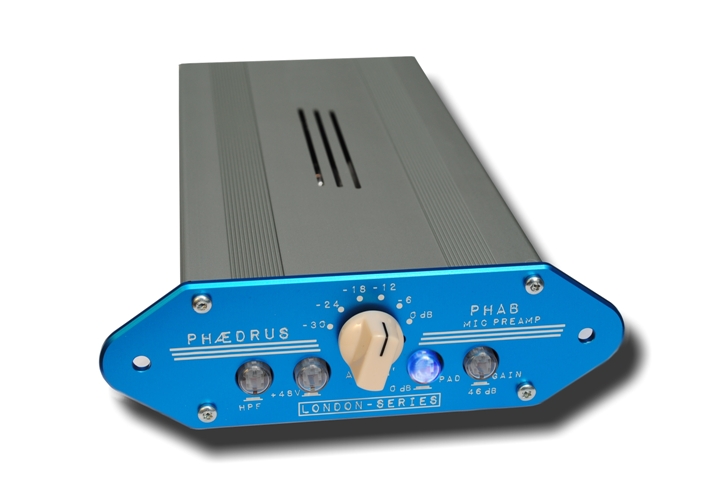
The Phædrus Audio PHAB was developed from our work on the LONDON Console - a recreation of the famous EMI, REDD, all valve (vacuum tube) mixer used to record The Beatles.


Although the LONDON Console has provoked lots of interest from all over the world, only a very few could afford a full console. Moreover, given the highly "tracked" nature of most modern production, often all that is required to obtain the magic "Beatles sound" on a track-by-track basis, is one, or a few, components from within the full console. We therefore felt there was a roll for a range of small, modular products; each with a specific role within the modern studio.

The PHAB (and the new PHILTER) are each based around the fundamental building-brick of the REDD consoles: the modular amplifiers. In the famous EMI REDD mixers, these amplifiers were either the German manufactured V72(S) amplifiers

or the, very rare, EMI built, REDD.47 amplifiers.

V72 and REDD.47 modular amplifiers

Ironically, despite the fact that many more V72 amplifiers exist than do REDD.47s, the EF804 valves which the German amplifiers use are no longer in current production and are becoming very expensive: whereas the EF86 and ECC88 (E88CC) valves employed in the REDD amplifiers remain in production and are widely available. So, a new amplifier, designed from the common source of Mullard's reference audio designs, and thereby sharing a common heritage with the REDD amplifiers, was developed.

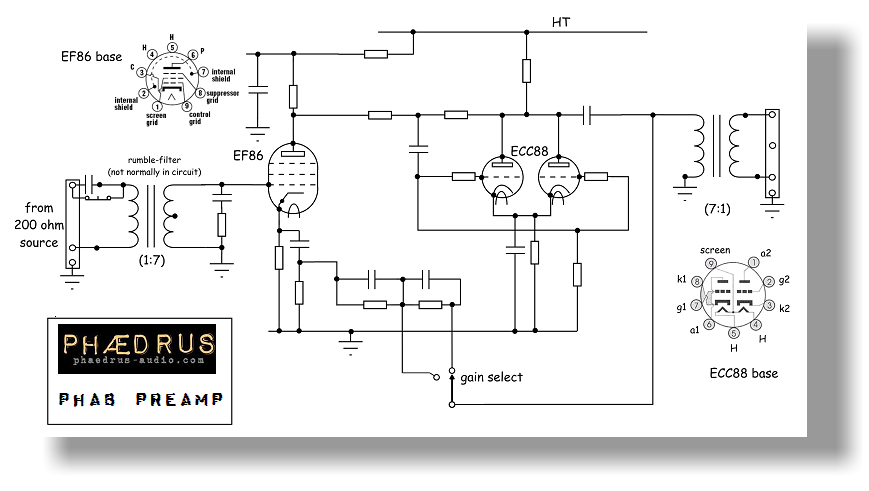
We called this amplifier the Phaedrus "PHILHARMONIC" (literally, music loving). A dozen of these PHILHARMONIC amplifier form the backbone of the Phædrus Audio LONDON Mark II console and the amplifier is the heart of the PHAB, PHAME and PHI products. (The circuit diagram of the PHILHARMONIC amplifier circuit is given below.)


PHILHARMONIC, modular amplifier - inspired by the best

.....and using ONLY valves (tubes) for amplification

The Phædrus Audio PHAB microphone preamplifier is essentially the front-end of a single-channel of the LONDON console, in which PHILHARMONIC modular-amplifier is combined with a rotary attenuator, switchable pad, high-pass filter and gain-switching circuitry similar to that employed in the famous sixties consoles.


Construction - or star earths (grounds) and curly tracks

Given their vintage, the V72 amplifiers and the REDD.47 amplifiers were built on a metal chassis, with the components hardwired onto tag-strips. Although Phædrus Audio equipment uses printed circuit boards to ensure consistent performance and reliability, the equipment follows "classic" practices such as star earths and "natural contour" tracking, just like hook-up wire.

Every Phædrus Audio PHAB, PHAME and PHI product is hand assembled and individually tested. A test pro-forma is provided with every unit. Phædrus Audio offer comprehensive service for products both inside and outside of their warranty period.


About Valves (Vacuum Tubes)

Valve (tube) types

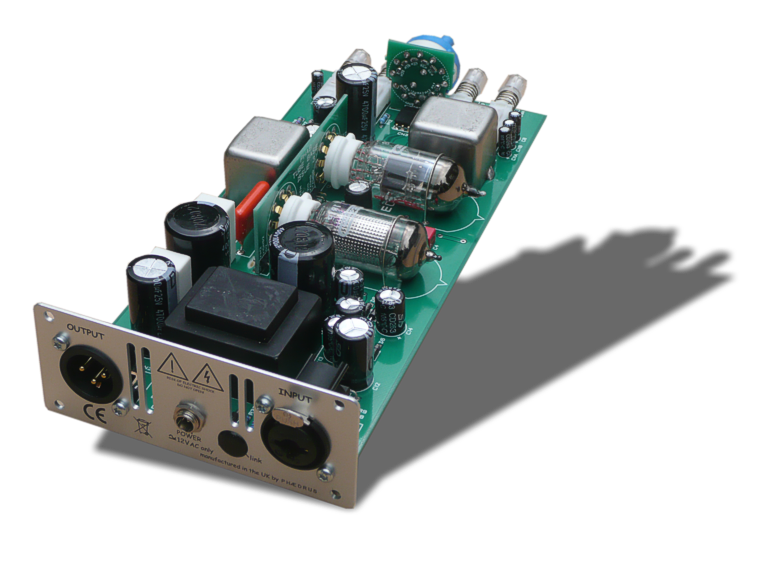
The Phædrus Audio PHAB and PHAME preamplifiers employ an EF86 pentode input valve (tube) and an ECC88 valve (tube) as the output device. Positions for the valves are very clearly marked on the PCB silkscreen as indicated in the illustration.

The valves (tubes) that are installed in Phædrus Audio's products during assembly are selected to give the best possible performance. We offer versions of all products with NOS (rather than current production) valves. But these must be chosen carefully, and be pre-screened. Replacing the supplied valves (tubes) with different, collectible, or "high-end" valves (tubes) types may not affect any improvement and might cause deterioration of performance.

EF86

The EF86 is a low noise pentode, originally manufactured by many different factories and branded by Philips, Mullard, Telefunken, Valvo, and GEC, TESLA and Siemens/RFT. Many NOS valves are still available. Equivalents include the CV2901 (the UK service designation for the EF86) and the CV4085; a special quality version for military use. The EF86 tube is still being produced in Russia and in the Slovak Republic under JJ Electronics brand name (formerly Tesla). Chinese close equivalents are also still being manufactured.

ECC88

The ECC88 is a frame-grid, sharp cut-off, twin (dual) triode with an internal, separating screen. The valve was originally designed for service in the front ends of VHF radio receivers. The ECC88 (E88CC) tube type is equivalent to the North American 6DJ8 tubes and the (rare) military branded CV2492. The transposition of the figures from ECC88 to E88CC was Mullard's way of denoting a special quality build and is equivalent to the US 6922. Russian 6N1P tubes and the Chinese 6N1 tube are NOT equivalent. NEVER install a 6N1(P) in the Phædrus Audio PHAB or PHAME product. The ECC88 valve is sill being manufactured in China and in the Slovak Republic under JJ Electronics brand name (formerly Tesla).

Valve (tube) lifetime

You should replace the valves in the tubes in the Phædrus Audio products only when you start to notice changes in the sound quality. If the gain of the preamplifier decreases noticeably, then this is certainly evidence of the onset of valve (vacuum tube) failure. Before this, the tone may become "dull" and transients may be become "blunted".

That said, the lifetime of a valve (tube) is largely determined by the lifetime of its cathode emission and the small-signal valves (tubes) used in the PHAB, PHAME and PHI use oxide cathodes, which can provide adequate cathode emission for 100,000 hours or more. That's over eleven year's continuous use. So do not replace valves (tubes) just because they have seen a few years service.

Phædrus Audio Ltd. can provide suitable valves (tubes) as spares which, after a burn-in period, are screened for best performance in your Phædrus Audio product. These are available as line items:

Please contact your dealer or Phædrus Audio Ltd. for current prices.


Instructions for use

PHAB - Application and connections

Mixer and computer interface manufacturers operate in a very competitive environment. Even a small mixer must (by definition) contain 8, 16 or perhaps 32 microphone amplifiers. Similarly, a computer interface designer has to "shoe-horn" a microphone amplifier into a box with a host of other features and a noisy, semi-digital environment. Unsurprisingly, these amplifiers are designed on a careful budget and contain some compromises. Hence, the use of a few dedicated, stand-alone microphone preamplifiers, solely designed with sound-quality in mind, can transform the quality of your recorded signals. That is the aim of the Phædrus Audio PHAB tube microphone preamplifier: to offer just such a no compromise microphone amplifier in a product which incorporates the standards and qualities adopted in classic recording gear. A block diagram of the PHAB is given below. The unit is connected into a typical system as shown.

Block diagram of PHAB

Controls

Input rotary attenuator, Pad and Gain switch

The PHAB microphone preamplifier operates with a constant-gain amplifier and attenuates the signal reaching the amplifier for level control. This is NOT common with modern equipment; in which the gain is adjusted by modifications to the feedback network. Yet this approach was completely standard in the 1950s and 1960s.

The Phædrus Audio PHAB tube preamplifier is built around a modular amplifier with a fixed gain of +40dB (with a switch available to raise this to approximately +46dB). This amplifier is preceded by a rotary, switched attenuator control, offering attenuation of 0 to -30dB in steps of 6dB. A further pad (operated by a front panel switch) is available, to increase the attenuation to -40dB; thereby matching the gain of the modular amplifier and reducing the overall unit gain of the equipment to unity. These controls (the input attenuator, pad and the gain switch) are used to set the overall preamplification level of the unit and feed a suitable electrical level to your downstream equipment.

Normal operation should be to operate WITHOUT the -10dB pad engaged and with the preamplifier gain set to 40dB. Only operate the pad switch when the signal from the microphone is too great for attenuation via the rotary attenuator control: and only operate the +46dB gain switch when the signal from the microphone is too low, even when the rotary attenuator is set to 0dB.

HPF (rumble filter)

By virtue of its very high quality input and output transformers and its minimalist, wideband, valve circuitry, the pass-band of the Phædrus Audio PHAB preamplifier is extended in both the bass and extra-high frequency ranges. Due to this, unwanted, very low frequencies, due to traffic or air-conditioning "rumble" may be picked up by the microphones and amplified. The high-pass filter (HPF) filters out these frequencies and prevents them from either, intermodulating with the wanted signals with in the microphone preamp' itself, or, being fed to downstream equipment. This filter section is engaged by depressing the HPF switch.

+48V "Phantom" supply

An internal phantom supply is provided to power the microphone connected to the input. This supply is engaged by depressing the "+48V" switch on the front panel of the unit. Although this supply is designed to "ramp-up" slowly, it is NEVER a good idea to switch phantom power onto a microphone on a channel with an open fader because it can create "pops and bangs" which can damage electronic equipment, speakers and fray nerves! Always mute any following circuit before switching on the phantom (+48V) supply. To avoid loud transients, always make sure phantom power is off when connecting or disconnecting microphones.This supply is designed to support the hungriest of microphones.


Links

Back to home page

Address all mail to sales@phaedrus-audio.com


Maidstone . Kent . UK .


© Phædrus Audio 2012. All rights reserved.