

Users of phonograph equipment have long recognized that the conventional arrangement of a phonograph pickup at the end of a pivoted arm has a built-in low-frequency stability problem.** A Vibration-Stabilizer System for Phonograph Reproduction. ANDERSON, C.R. JOURNAL OF THE AUDIO ENGINEERING SOCIETY, 1979 APRIL. VOLUME 27, NUMBER 4.
The PHLUX-DiVA is a new addition to the PHLUX active cartridge range, with unique, integrated tonearm stabilisation technology. The background to this product is given in or blog about tonearm resonance.
It's a common observation that, when a stylus is lowered onto a record, it "sinks" slightly as the stylus suspension is compressed. This is due to the stylus compliance which is a measure of the 'springiness' of the suspension.
Another everyday fact that the tonearm has mass - or effective mass, its moment of inertia about its pivots.
Just as a weight hanging from a spring has a natural resonant frequency, the stylus bearing compliance resonates with the effective mass of the tonearm.
Commonly this frequency is known as the tonearm resonance frequency and it's usually around 10Hz. But this resonance is not strictly due to the tonearm itself. So, to distinguish this effect from the resonant modes of the tonearm tube, we refer to it here as tonearm instability.
In chapter three of the Needle-drop Handbook, various solutions to tonearm instability are covered. These include viscous oil damping, Shure's Dynamic Stabiliser, and active servomotor techniques employed in late-era turntables from SONY, Kabushiki Kaisha Denon and The Victor Company of Japan (JVC). But, worthy though each of these ideas were, they had puzzlingly little long-term effect on tonearm design. As Stanley Lipshitz said just prior to the end of the phonograph record as a mass music carrier,
The typical arm-cartridge [dynamic] system proves to be a rather poor one as far as meeting the basic requirements for stable, distortion-free tracking of record warps and audio signals is concerned.....[L]ack of damping in the arm itself is a bad compromise in principle, which unfortunately represents the most common situation in practice.**Impulse Response of the Pickup Arm-Cartridge System. Lipshitz, S.P. JAES January / February 1978, Volume 26, Number 1 / 2.
A glance at modern turntables and tonearms reveals very little has changed since Lipshitz appraisal in 1978. The vinyl revival has simply revived the "bad compromise" of the undamped tonearm.
We have long harboured an ambition to find a solution to tonearm instability and the PHLUX-DiVA is based on the technology of Dynamic Vibration Absorbers or Tuned Mass Dampers first introduced to tonearm design by Ben Bauer (On the Damping of Phonograph Arms. Bauer, B. JAES July 1963, Volume 11, Number 3). Indeed, the DiVA stands for Dynamic Vibration Absorber.
The DiVA in PHLUX-DiVA stands for Dynamic Vibration Absorber.
This technology originated with Den Hartog of Westinghouse Electric nearly a century ago are used in a wide range of real-world applications. They are used to reduce vibrations in bridges caused by moving loads. For example, dynamic vibration absorbers were amongst the measures used to "tame" London's famous Millennium Bridge (the so-called "Wobbly Bridge"). And they are employed in tall buildings & towers to resist wind and earthquake excitations.
The result is an active cartridge that incorporates an electronic stabiliser. The active stabilisation components are powered from the same phantom power source that energises the impedance converter circuitry in the standard PHLUX-II/PHLUX-III cartridge.
The performance of the active, stabilised cartridge is illustrated below. First the lateral tonearm instability using the Stereo Test Record from Hi-Fi Sound (HFS81) record. In the following, the upper (green) trace is the standard PHLUX-II/PHLUX-III cartridge; the lower (red) trace the PHLUX-DiVA cartridge.
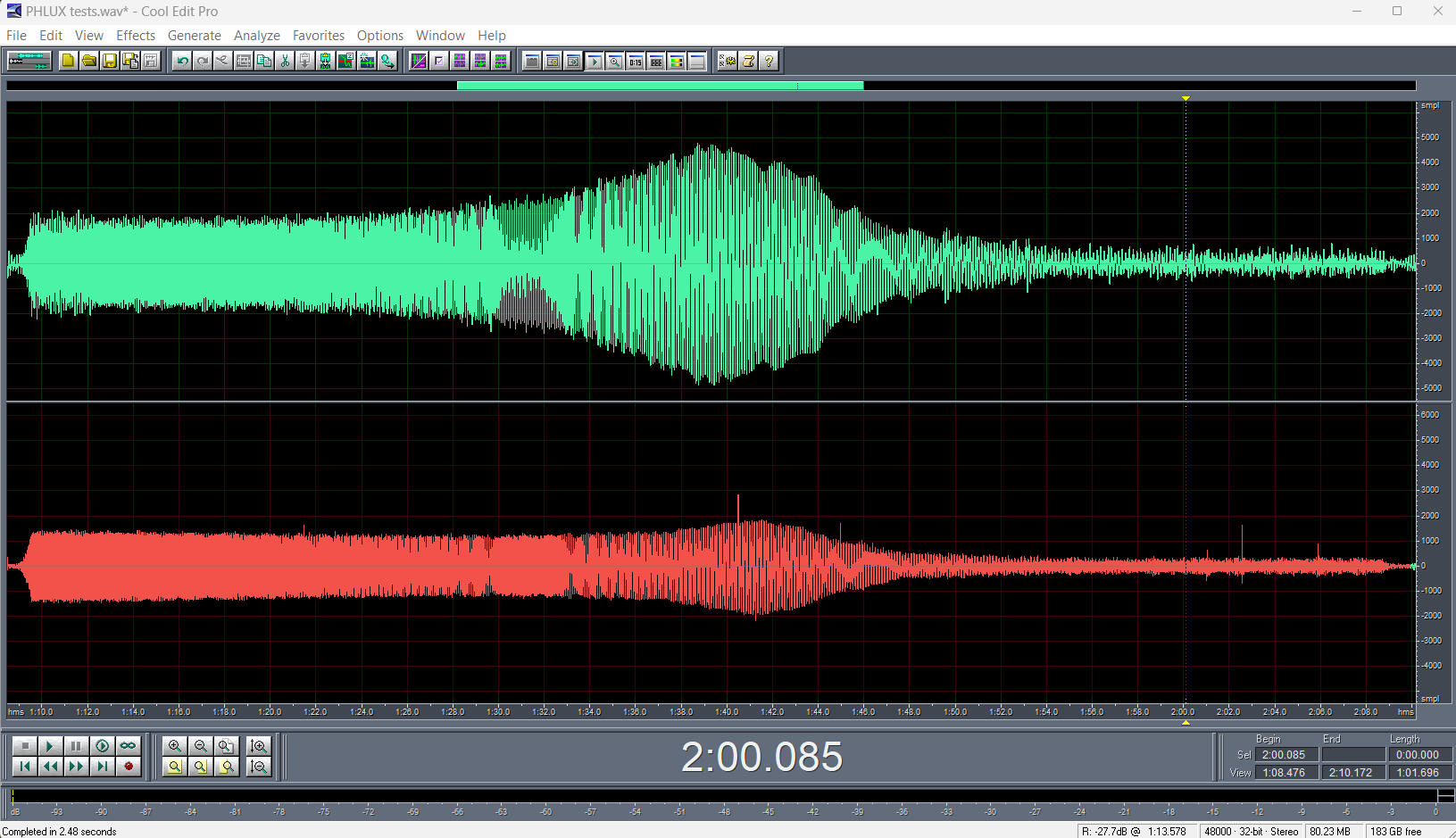
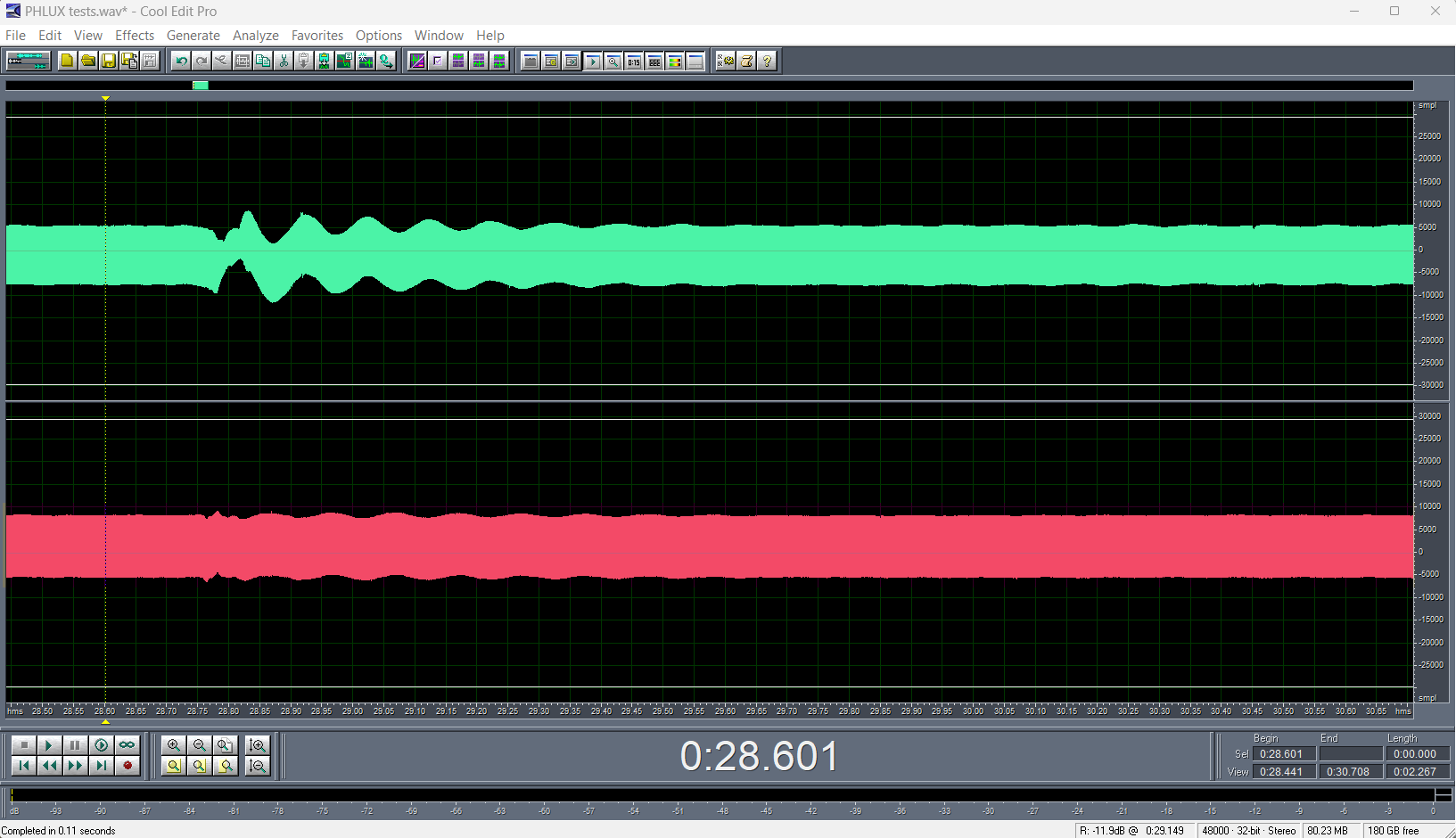
As you can see, the arm resonant instability (around 10Hz) is almost totally eradicated. We also subjected the active absorber cartridge to a physical impulse with the cartridges tracking a band of 3150Hz tone. Once again, the upper (green) trace is the standard PHLUX-III, the lower (red) trace the PHLUX-DiVA cartridge.
The chapter on the full technical explanation and development of the PHLUX-DiVA cartridge, as it will appear in a forthcoming edition of the Needle-drop Handbook is available on request. Write to sales@phaedrus-audio.com.

Address all mail to sales@phaedrus-audio.com